
English 
T: 400-6130-885
E: cservice@xx.com
E: cservice@xx.com
5th floor, Financial Innovation Plaza, 8-2 Pusi Road, Jiangbei New District, Nanjing
Friendly link (QQ: 3004257586)
Friendly link (QQ: 3004257586)

Views: 0 Author: Site Editor Publish Time: 2026-08-10 Origin: Site
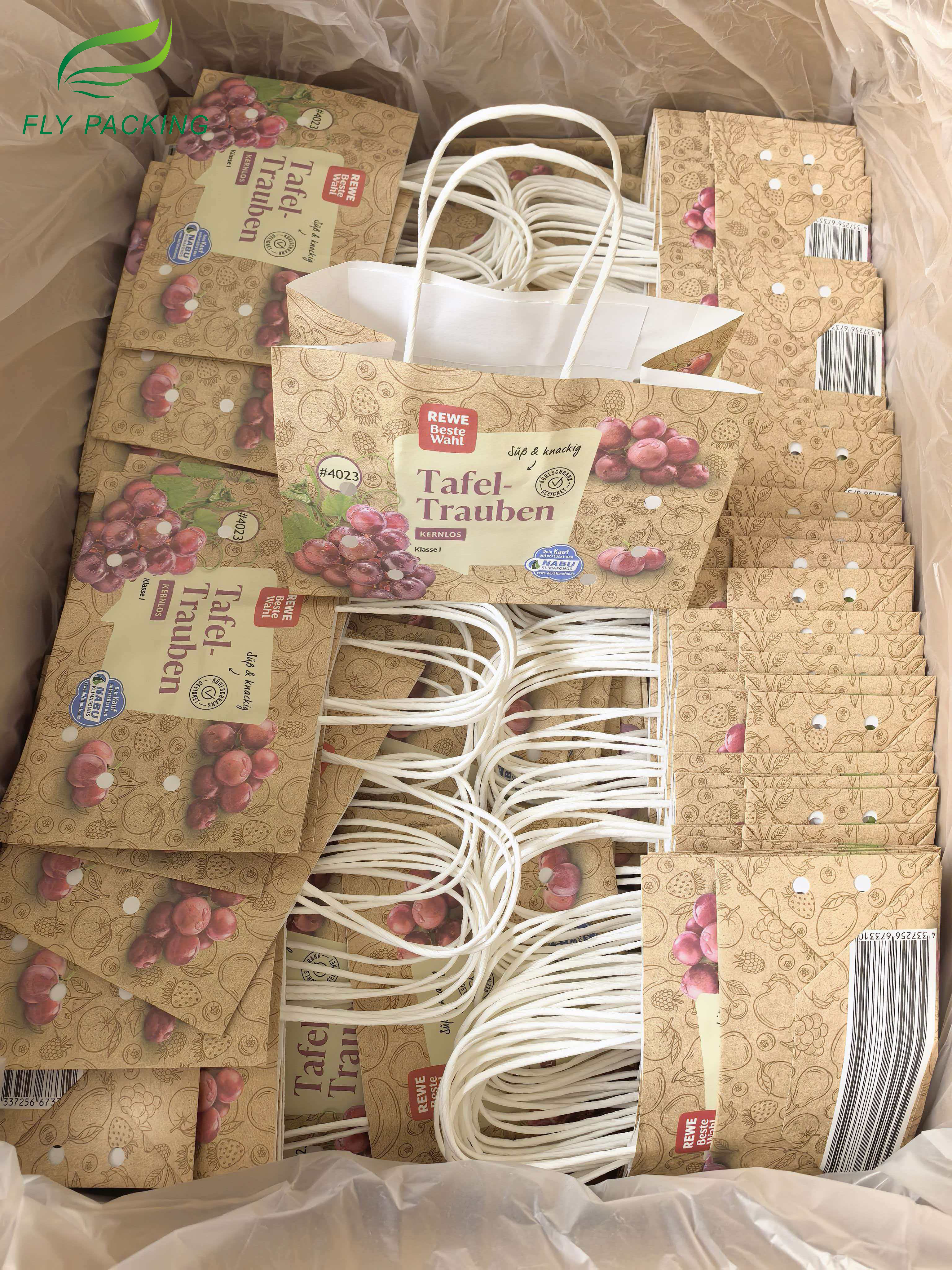
Fruit paper bags—particularly grapes packaging paper bags made from wet-strength kraft paper—protect fresh produce during transport and storage while offering an eco-friendly alternative to plastic. Key features to look for include macro perforated holes for ventilation, food-grade materials, and durable twisted paper handles.
Plastic packaging is losing ground fast. Retailers, growers, and distributors are under growing pressure to switch to sustainable alternatives—and fruit paper bags have emerged as one of the most practical solutions on the market. They keep produce fresh, reduce plastic waste, and can even carry your brand's logo.
But not all fruit paper bags are created equal. The right bag for table grapes looks very different from a general-purpose produce bag. Choosing the wrong one can lead to moisture damage, crushed fruit, or poor shelf presentation. This guide breaks down everything you need to know about grapes packaging paper bags and fruit packaging paper bags—from materials and construction to what to look for when sourcing from a packaging bag factory.
Fruit paper bags are specially designed packaging solutions made from food-grade paper materials. For grapes specifically, the packaging requirements are more demanding than for many other fruits. Grape bunches are heavy, moisture-prone, and highly perishable—which means the bag needs to do several things at once.
A high-quality grapes packaging paper bag must:
Support significant weight without tearing or losing structural integrity
Allow airflow to prevent mold and moisture buildup
Resist water in cold storage and refrigerated transport environments
Meet food safety standards throughout the supply chain
This is why leading packaging bag factories use wet-strength paper rather than standard kraft. Wet-strength paper retains its structural integrity even when exposed to humidity or condensation—a critical feature for fresh fruit packaging.
The material specification is the most important factor when evaluating any fruit paper bag. Fly Packing Co., a China-based packaging bag factory operating since 2002, produces grapes packaging paper bags using 80–115 GSM wet-strength paper in kraft brown or plain white. Here's why each element matters:
Material Feature | Why It Matters |
|---|---|
80–115 GSM wet-strength paper | Handles heavier fruits without tearing; resists moisture |
Macro perforated holes (8mm diameter) | Promotes airflow to keep grapes fresh longer |
Food-grade certification | Safe for direct contact with fresh produce |
Recyclable and plastic-free | Reduces environmental impact across the supply chain |
Twisted paper handle (optional) | Provides a secure, comfortable grip for consumers |
The macro perforated holes deserve special attention. Standard paper bags trap moisture, which accelerates mold growth on grape skins. The 8mm perforations allow air to circulate freely—mimicking the breathability of traditional mesh bags while offering far superior print quality and structural strength.
When evaluating a fruit packaging paper bag from any supplier, there are five core features worth examining closely.
This is non-negotiable for grapes. Regular paper loses up to 70–80% of its tensile strength when wet. Wet-strength paper is chemically treated to maintain its strength even after prolonged moisture exposure. For refrigerated fruit, this is essential.
Hole diameter matters. Too small and airflow is restricted. Too large and the structural integrity of the bag is compromised. An 8mm macro perforation strikes the right balance for grape and stone fruit packaging.
A firm bottom ensures the bag sits flat on retail shelves and doesn't buckle under the weight of the fruit. Look for clean sawtooth edges and consistent printing quality—these are signs of precise manufacturing at the factory level.
For retailers and growers, branded packaging is a marketing asset. A capable packaging bag factory will support CMYK and Pantone color printing from AI, CDR, EPS, and PDF artwork files. This makes it possible to produce eye-catching, on-brand bags without a prohibitive setup cost.
Standard dimensions for grapes packaging paper bags typically include:
135 × 100 × 110mm
180 × 60 × 90mm
180 × 90 × 110mm
180 × 100 × 110mm
180 × 100 × 130mm
Custom sizes are also available from most direct-factory suppliers, making it easier to accommodate different bunch weights and retail formats.
Both handle and no-handle configurations are common in the market. The right choice depends on the use case.
Bags without handles are typically used in high-volume retail or wholesale settings where the bag is placed directly in a larger container or tray. They're simpler to produce and slightly more cost-effective.
Bags with twisted paper handles are better suited for direct consumer-facing retail. The twisted paper handle provides a comfortable grip, supports the weight of the grapes, and adds a premium feel to the product presentation. For supermarket shelves and farmers' markets, handles make a visible difference.
Both configurations can be produced from the same wet-strength kraft material, so the freshness and structural benefits remain consistent across either option.
Sourcing directly from a packaging bag factory—rather than a distributor—offers several advantages: lower unit costs, faster lead times, and direct access to customization options. Here's what a reliable factory should be able to offer:
Production capacity: A well-equipped facility can produce 100,000–150,000 bags per day, making large-volume orders feasible without extended lead times.
Sample availability: Reputable factories offer free samples of standard sizes, with a lead time of 1–3 days. Custom samples may take 5–15 days depending on complexity.
Shipping lead time: Standard production runs ship within 15–25 days after deposit confirmation and artwork approval.
Flexible payment terms: Look for factories offering T/T and L/C payment options, with delivery terms including EXW, FOB, CNF, and CIF.
Quality control: Every production step—from material inspection to finished product—should be checked before shipment.
Plastic-free packaging is no longer just a marketing angle. Regulatory pressure in the EU, UK, and parts of Asia Pacific is accelerating the shift away from single-use plastics in fresh produce. Fruit paper bags made from recyclable, food-grade kraft paper offer a direct substitute that meets both consumer expectations and emerging compliance requirements.
Critically, the environmental benefits don't require a trade-off on performance. Wet-strength kraft paper bags handle heavier loads, breathe better, and print more cleanly than most plastic alternatives—making them a practical upgrade, not just an ethical one.
Grapes packaging paper bags have come a long way from basic brown kraft sleeves. Today's best options combine wet-strength durability, macro perforated ventilation, food-grade safety, and custom branding capability—all in a fully recyclable, plastic-free format.
For growers, distributors, and retailers looking to upgrade their fruit packaging, the first step is finding a packaging bag factory that can deliver consistent quality at scale. Request samples, review the material specifications, and confirm the factory's production capacity and lead times before committing to a full order.
The right fruit paper bag protects your product and your brand—both at the same time.
The best material is 80–115 GSM wet-strength paper. Wet-strength paper retains its structural integrity when exposed to moisture, making it suitable for refrigerated storage and transport. It is also food-grade, recyclable, and plastic-free.
The holes—typically 8mm macro perforations—allow air to circulate around the fruit. This ventilation reduces moisture buildup and slows mold growth, helping grapes stay fresh longer during storage and retail display.
Yes. Most packaging bag factories support custom branding using CMYK or Pantone color printing. Artwork can be submitted in AI, CDR, EPS, or PDF format. Customization options typically include color, size, and handle configuration.
Direct factory suppliers often accept orders of any quantity, with pricing determined by volume. Larger orders yield lower unit costs. For exact pricing, it's best to submit your artwork and required quantity directly to the factory.
Standard lead time is 15–25 days after deposit confirmation and artwork approval. Free samples of standard sizes are typically available within 1–3 days.
Yes. The same wet-strength kraft bags used for grapes are also suitable for stone fruits such as peaches, plums, and nectarines. The structural properties—load-bearing strength and ventilation—apply equally to both fruit categories.

| | 1/F, NO.81, CHANGZHEN ROAD, SHUIKOU TOWN, KAIPING CITY, GUANGDONG, CHINA |
| | +86-0-136 3183 6942 / +86-0-134 2677 9895 +86-750-2280358 |
| |


